
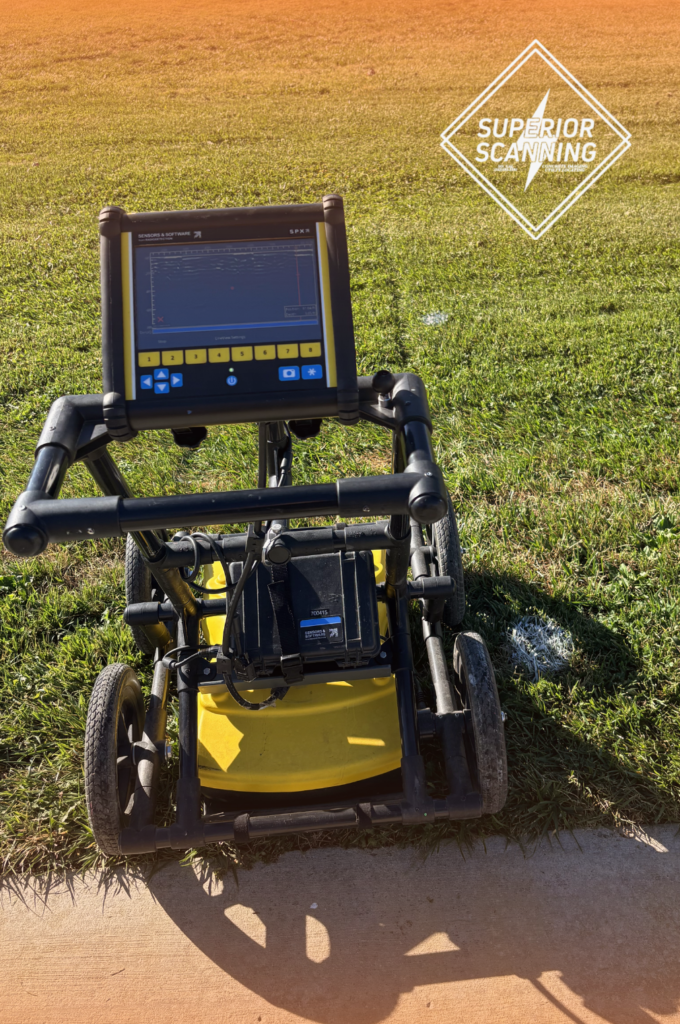
A nicked gas line, a cored post-tension cable, a snapped conduit under a fresh slab. Every one of those mistakes starts the same way, with a crew guessing at what sits below. Ground-penetrating radar systems take out the guesswork by showing what lies beneath soil and concrete before anyone cuts or digs. The trouble is that no single radar setup sees everything, so the right one depends on the job, and picking it is where a crew like Superior Scanning earns its keep. Match the system to the site, and the ground stops holding surprises.
Table of Contents
Don’t Cut, Core, or Drill Blind
Superior Scanning is trusted on complex job sites
What Are Ground Penetrating Radar Systems?
Ground-penetrating radar systems send radio waves into soil or concrete, then detect the echoes that bounce back from buried objects. Those echoes tell a trained operator how deep something sits, how big it is, and roughly where to find it. The technology behind ground-penetrating radar (GPR) remains the same across setups, but each system is tuned to a specific depth and target. That tuning is why one GPR scan can map a deep pipe, while another can read the rebar inside a floor.
What Affects GPR Detection?
A few things decide what a radar system can pick up:
- Antenna frequency, which trades depth for fine detail
- Soil and ground conditions, since wet clay cuts how far a signal reaches
- Target size and material, because larger, denser objects reflect more clearly
- Antenna setup, which shapes how the signal enters the ground

What Are the Main Types of GPR Systems?
Most systems are grouped by frequency, and that single choice determines how deep a scan goes and how much detail appears. Low frequencies go deep but show less detail. High frequencies stay shallow but read small objects clearly.
Low-Frequency Systems for Deep Scans
Low-frequency systems reach the deepest, which makes them the choice for large, buried targets. Crews use them to map bedrock, trace geology, find voids, and locate oversized or deep utilities. In dry, sandy ground, the signal can travel many feet down. The trade-off is detail, since small objects tend to blur once the scan reaches that range.
Medium-Frequency Systems for Utilities
Medium-frequency systems cover everyday utility work at moderate depth. This is the range most crews use for GPR utility mapping, where the goal is tracing pipes, conduits, tanks, and cables a few feet below grade. Firm, dry soil gives the cleanest read. Wet clay pulls the usable depth back, so results in soggy ground come with more caution.
High-Frequency Systems for Concrete
High-frequency systems are built for shallow, high-detail work inside concrete. A GPR scanner in this range detects rebar, post-tension cables, conduits, and voids, typically within the first 12 to 18 inches of a slab. Because the scan stays close to the surface, it shows small objects that a lower-frequency unit would miss. That detail is what keeps a saw or core bit off a live cable.
Don’t Cut, Core, or Drill Blind
Superior Scanning is trusted on complex job sites
How Are GPR Systems Set Up?
The same radar shows up in a few field forms:
- Handheld units, easy to move across tight spots and vertical walls
- Push-cart systems, steady and common for utility work over open ground
- Vehicle-mounted arrays, built to cover large sites fast

Which GPR System Does Your Project Need?
The right GPR system depends on what you need to find and how deep it sits. Point a concrete-tuned scanner at a deep utility, and the pipe never shows on screen. Run a low-frequency unit over a floor slab, and the rebar smears into noise. Frequency is only half the decision, because raw radar data still needs a trained operator to tell a real target from ground clutter. Superior Scanning matches the correct system to each site and reads the results, so a crew knows what sits below before the first cut or dig.
Don’t Cut, Core, or Drill Blind
Superior Scanning is trusted on complex job sites
Frequently Asked Questions
How deep can ground penetrating radar systems detect?
Depth depends on the setup and soil conditions, so a concrete scan reads the top 12 to 18 inches of a slab, while a low-frequency GPR scan can reach many feet in dry, sandy ground but far less in wet clay.
Can ground-penetrating radar detect plastic or PVC pipes?
Yes, GPR reads contrasts in the ground, so it can find non-metallic pipes that metal detectors miss, though a small, empty PVC line in similar soil can be tough to spot.
What can ground penetrating radar not detect well?
GPR struggles with targets buried in wet clay or salty soil, with very small or very deep objects beyond the antenna’s range, and with identifying the exact material, which usually requires a trained reader.
Does soil type affect how well GPR works?
Yes, dry, sandy, and gravelly ground provides the best depth and clarity, while wet clay and other conductive soils reduce the distance the signal travels.
How much does a ground penetrating radar scan cost?
Price shifts with site size, depth, and scope, so the accurate answer is a quote; contact Superior Scanning for an estimate based on the actual job.
Why Guess What’s Below?
The right radar turns unknown ground into a clear picture, and a scan costs far less than hitting a live line. Ground-penetrating radar systems only pay off when the setup fits the target, and someone can read the screen. Book a scan with Superior Scanning before breaking ground, and let the crew handle both.
