
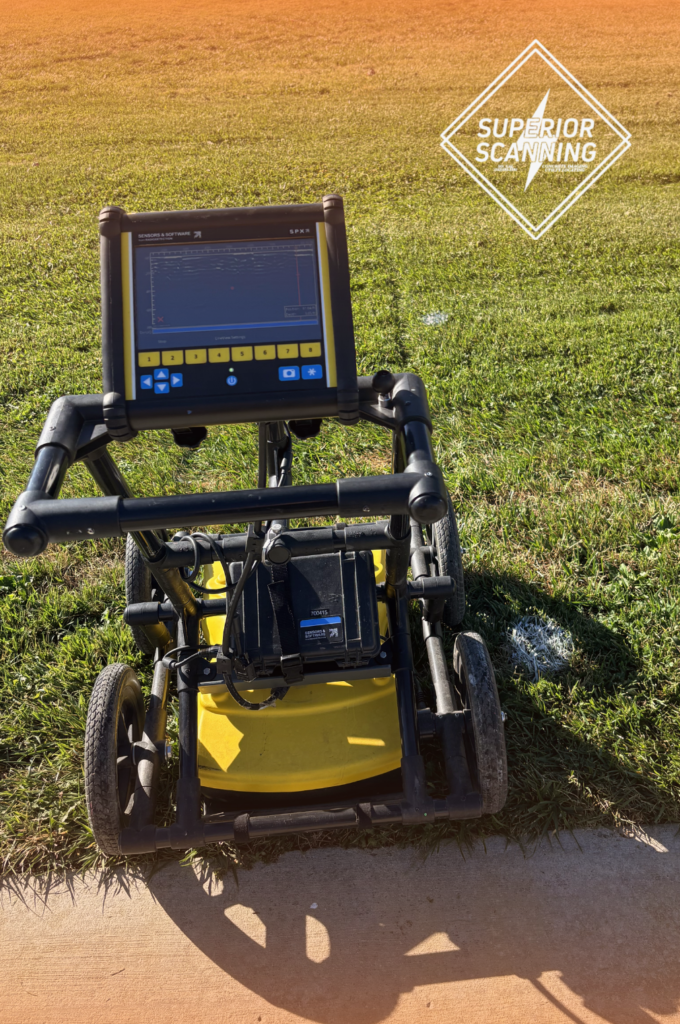
A drill only needs a few inches to hit hidden reinforcement. Because rebar depth varies by concrete member, exposure, and structural design, locating it beforehand is crucial. Rebar locating services use Ground Penetrating Radar (GPR) to map the locations of steel and estimate cover depth before drilling or cutting. Federal Highway Administration guidance identifies reinforcement mapping as an established GPR application.
Superior Scanning provides GPR-based concrete scanning for slabs, walls, decks, and columns, giving contractors essential field data before starting intrusive work.
Table of Contents
Don’t Cut, Core, or Drill Blind
Superior Scanning is trusted on complex job sites
How Deep Is Rebar in Concrete?
Rebar does not have one universal depth in concrete. The distance from the concrete surface to the reinforcing steel depends on the required cover, structural design, exposure conditions, bar arrangement, and the type of concrete member.
American Concrete Institute guidance shows why one number does not fit every situation. For example, ACI 318-19 calls for 3 inches of cover where concrete is cast against and remains in contact with the ground, but that requirement does not apply to every slab, wall, beam, or column.
Design-Driven Cover Depth
Concrete cover is the distance from the concrete surface to the outer surface of the reinforcing steel. Structural drawings and applicable design requirements establish the intended cover for each member and exposure condition.
Multiple Reinforcement Layers
A slab or wall may contain more than one layer of steel. Upper and lower reinforcement mats can sit at different depths, so the first bar detected may not be the only reinforcement below the surface.
Variable Field Conditions
Actual rebar locations should not be guessed from slab thickness alone. Placement tolerances, construction changes, repairs, and incomplete drawings can all make field conditions differ from expectations.
Why Does Rebar Depth Vary?
Several factors can change how far reinforcement sits below the concrete surface:
- Structural element: Slabs, walls, beams, columns, and foundations use different reinforcement layouts.
- Exposure: Concrete exposed to weather or soil may require different cover than protected interior concrete.
- Bar size and spacing: Reinforcement dimensions affect the designed arrangement.
- Multiple mats: Upper and lower mats sit at different elevations.
- Structural design: Loads and member thickness influence the placement of reinforcement.
- Construction conditions: Installed steel may not match assumptions based only on visible concrete thickness.
For field planning, rebar locating services give crews more useful information than estimating bar depth from the surface alone.

How Do Professionals Locate Rebar?
Professionals commonly locate rebar by scanning the concrete with high-frequency ground-penetrating radar and interpreting reflections from embedded steel. FHWA identifies GPR as a nondestructive method for mapping the position of reinforcement and estimating cover depth.
The work combines the scanner, a planned scan pattern, technician interpretation, and surface markings. Professional GPR concrete scanning services use this process to give field crews usable information before they cut or drill concrete.
GPR Concrete Scanning
Ground-penetrating radar systems send electromagnetic energy into concrete and record reflections from changes inside the material. Steel elicits a strong response because its electrical properties differ markedly from those of concrete.
Grid-Based Scanning
Technicians usually move the scanner across the target area in multiple directions. The pattern helps show bar orientation, spacing, and crossing reinforcement, rather than relying on a single scan line.
FHWA notes that closely spaced scan grids can map reinforcement, conduits, cables, and other embedded features.
Surface Marking
Interpreted targets can be marked directly on the slab, wall, or deck. Superior Scanning describes field markouts as a crucial part of its rebar scanning services workflow.
A line marking service based on scan results can help crews plan cut lines, anchor points, and core locations, but surface markings should not be treated as a guarantee that every concealed feature has been identified.
How Do Ground-Penetrating Radar Systems Detect Rebar?
GPR detects rebar when electromagnetic waves reflect from steel embedded in concrete. A technician interprets those return signals to estimate bar position, spacing, and depth.
The scanner does not produce a simple photograph of the slab. The display shows radar responses that require interpretation.
Reflected Radar Signals
Rebar commonly appears as a recognizable curved response in GPR data. Some crews casually use terms like “ground radar” or “GPR locator,” but “ground-penetrating radar” is the technical term for the method.
Estimated Rebar Depth
Depth is calculated using radar travel time and the estimated speed of the electromagnetic wave through concrete. Concrete properties affect that speed, so calibration and technician judgment matter.
FHWA notes that GPR can estimate reinforcement cover and that calibration against known conditions can improve depth calculations.
Don’t Cut, Core, or Drill Blind
Superior Scanning is trusted on complex job sites
What Else Can Concrete Scanning Services Find?
Depending on the concrete, equipment, target depth, and site conditions, GPR scanning may indicate:
- Rebar and reinforcement mats
- Post-tension tendons or cables
- Electrical conduits
- Embedded pipes
- Changes in slab thickness
- Certain voids or anomalies
- Other detectable features inside concrete
FHWA identifies reinforcement, cables, conduits, voids, and thickness changes among established GPR applications. Not every radar response can be positively identified from GPR data alone, so interpretation remains important.
When Are Rebar Locating Services Needed?
Rebar locating services are most useful before work that could intersect reinforcement or another concealed feature. Scanning gives crews field information while they still have time to adjust a planned penetration or cut.
Superior Scanning lists core drilling, saw cutting, anchoring, renovation work, and new mechanical, electrical, and plumbing penetrations among common reasons for rebar scanning.
Before Core Drilling
Concrete core drilling can cross rebar, conduit, or post-tensioning if you don’t check the proposed hole first. Contractors seeking GPR construction support often use concrete scanning before selecting final core locations.
Before Saw Cutting
A scan can help show reinforcement patterns and other detectable targets along a proposed cut path. The results give the cutting crew more information before the saw reaches the slab.
Before Anchoring
Anchors, bolts, equipment bases, and similar installations may require several inches of drilling. Knowing reinforcement depth and spacing can help identify conflicts during layout.
During Renovations
Renovation plans may rely on incomplete or outdated drawings. Field scanning can supplement available records when you need to check existing reinforcement before modifications begin.

How Is Rebar Locating Different From Private Utility Locating?
Rebar locating focuses on features embedded in concrete, while utility locating generally investigates buried lines below soil, pavement, or other site surfaces. Both services may use GPR, but equipment, scan depth, targets, and field methods can differ.
Concrete-Embedded Targets
Concrete scanning commonly uses higher-frequency equipment suited to shallow, detailed imaging. The main targets may include rebar, post-tensioning, conduits, and embedded pipes.
Underground Site Utilities
A utility locator may use GPR along with electromagnetic locating to trace buried services. Utility locating services, private utility locating, GPR utility mapping, and other underground locating services focus on subsurface infrastructure outside the concrete member.
A private utility locator may also use records, surface clues, or conductive-line tracing. Utility locators choose methods based on utility material, depth, access, and site conditions.
What Affects Rebar Locating Results?
GPR results depend on concrete conditions, reinforcement layout, surface access, equipment, and technician interpretation. One scanner depth or accuracy figure should not be treated as a guarantee for every slab.
Concrete Conditions
Moisture, conductivity, age, and material properties can affect radar-wave speed and signal strength. FHWA notes that conductive or moisture-rich concrete can reduce penetration.
Reinforcement Density
Closely spaced bars and multiple reinforcement mats can make it harder to separate deeper responses. Dense steel may also reduce the amount of radar energy that reaches features below the upper mat.
Surface Access
The scanner needs enough room to move across the work area. Walls, equipment, edges, thick coverings, and blocked areas can reduce usable coverage.
Technician Interpretation
Collecting data is only part of the work. A trained technician must identify meaningful radar responses, compare scan directions, and decide which features to mark.
How Should Scan Results Be Used?
Rebar scan results should support drilling, coring, cutting, and construction planning, not replace structural engineering decisions. Field markings show interpreted reinforcement patterns and other detected features within the scanned area.
Field Layout Support
Crews can use surface marks to adjust proposed cores, anchors, cuts, or penetrations. The markings provide practical field guidance before tools enter the concrete.
Structural Coordination
The appropriate structural professional should review any cutting, relocating, or modifying of structural reinforcement. GPR reduces uncertainty, but it does not make a structural design decision or guarantee a completely clear penetration point.
Don’t Cut, Core, or Drill Blind
Superior Scanning is trusted on complex job sites
Frequently Asked Questions
How deep is rebar usually placed in concrete?
Rebar depth varies by structural member, exposure, bar arrangement, and required concrete cover, so no single depth applies to all slabs, walls, beams, or foundations.
Can ground penetrating radar locate rebar in concrete?
Yes, ground penetrating radar is widely used to locate and map reinforcing steel in concrete without opening the slab or wall.
How accurate is GPR for locating rebar?
GPR can provide useful estimates of rebar position and depth when conditions are suitable, but concrete properties, reinforcement density, calibration, access, and interpretation affect the results.
Can GPR determine rebar depth?
Yes, GPR can estimate rebar depth from radar travel time and wave velocity, with calibration helping improve the depth calculation.
Should concrete be scanned before drilling or core cutting?
Concrete scanning is commonly used before drilling or core cutting to help crews identify likely reinforcement, conduits, post-tensioning, and other detectable features in the work area.
Cutting or Coring Soon?
Concrete thickness alone does not tell a crew how deep the rebar sits or where reinforcement crosses a proposed penetration. GPR can map reinforcement patterns and estimate concrete cover without opening the concrete first.
Superior Scanning provides rebar locating services for accessible slabs, walls, decks, columns, and other concrete elements throughout Southern California, with field markings for drilling, coring, and cutting.
If a proposed cut may alter structural reinforcement, coordinate the scan findings with the structural professional before work begins.
