
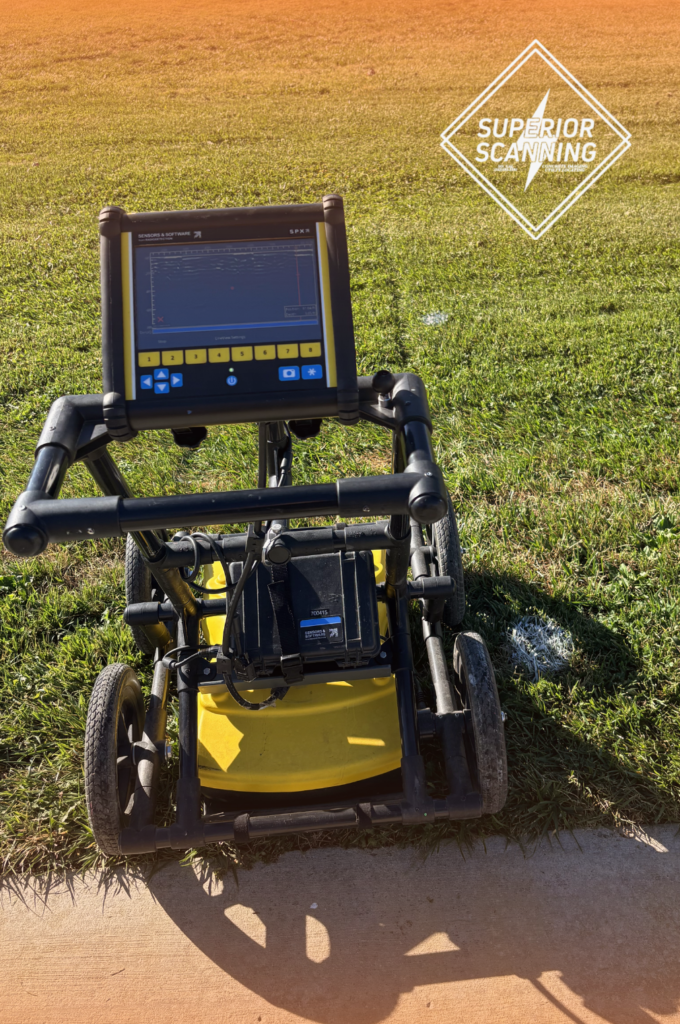

A slab can look uniform from the surface while hiding very different conditions below. Concrete radar, or ground-penetrating radar (GPR), uses electromagnetic energy to detect these hidden features. While slab thickness affects results, the Federal Highway Administration recognizes GPR applications that include mapping reinforcement, measuring concrete cover, and estimating concrete thickness. Moisture, conductivity, and rebar density also change what a scan shows.
Superior Scanning uses GPR-based concrete scanning before coring, cutting, drilling, and other intrusive work, ensuring crews can assess the accessible concrete before their project begins.
Don’t Cut, Core, or Drill Blind
Superior Scanning is trusted on complex job sites
Does Concrete Thickness Affect Radar Results?
Yes. Concrete thickness can affect concrete radar when a target sits deeper in the slab because a longer signal path can weaken the returning reflection. A thick slab can still produce useful data, especially when the target of interest is relatively shallow.
Longer Signal Travel
Radar energy must travel from the scanner to the target and back, so deeper features result in a longer path through the concrete.
Weaker Deep Reflections
Radar signals lose energy as they travel through materials. Conductive concrete can increase this attenuation and reduce usable penetration.
Site-Specific Results
Two slabs with the same thickness can scan differently because moisture, salts, reinforcement, frequency, and target size also affect the result.

How Does Concrete Radar Work?
Concrete radar sends electromagnetic energy into concrete and records reflections from changes within the material. A concrete scanner does not take a photograph of the slab, so a trained technician must interpret the collected radar data.
When scanning concrete, the goal is to recognize useful patterns and relate those responses to the work area.
Electromagnetic Radar Pulses
A GPR scanner sends electromagnetic signals into the concrete, and some of the energy reflects when it encounters a material boundary or an embedded object.
Reflected Target Signals
Steel often elicits a strong response because its electromagnetic properties differ markedly from those of concrete. This makes GPR useful for reinforcement mapping.
Interpreted Scan Data
A technician reviews GPR scan patterns to estimate the position and depth of detectable reinforcement, conduits, boundaries, or other targets.
What Limits Radar Depth in Concrete?
Several conditions can influence how deeply a concrete scanner can collect useful information:
- Concrete thickness: Deeper targets or back surfaces require longer radar travel paths.
- Moisture: Wet or conductive concrete can attenuate radar energy more quickly.
- Rebar density: Closely spaced steel can limit signal penetration below an upper reinforcement layer.
- Concrete composition: Material properties affect signal speed and attenuation.
- Target depth and size: Deep, small, or closely spaced targets can be harder to resolve.
- Antenna frequency: Higher frequencies provide more detail but typically reduce penetration, while lower frequencies reach farther but offer less detail.
- Surface conditions: Metal-backed coverings, obstructions, or poor scanner contact can reduce the amount of usable data.
No single maximum depth applies to all GPR concrete scanning equipment or every concrete structure. EPA guidance confirms that conductivity and signal frequency strongly affect GPR penetration, while higher frequencies generally trade depth for better resolution.
Don’t Cut, Core, or Drill Blind
Superior Scanning is trusted on complex job sites
How Deep Can a Concrete Scanner Detect Targets?
Concrete radar has no guaranteed scanning depth because useful penetration depends on equipment and site conditions. A quoted depth is an equipment capability under suitable conditions, not a promise that every target will appear at that depth.
Equipment-Dependent Depth
Superior Scanning reports handheld units such as the Proceq GP8000 as typically effective to about 18 to 24 inches under suitable conditions, with high-resolution imaging more commonly focused within about 12 to 14 inches. These figures describe company equipment and typical field conditions rather than a universal GPR limit.
Frequency and Resolution
Higher-frequency radar generally provides better shallow-depth detail, while lower-frequency radar can penetrate farther but with lower resolution.
Practical Detection Limits
Dense rebar, conductive concrete, weak target contrast, or poor access can reduce usable depth even when equipment is rated for deeper scanning.
What Can Concrete Radar Detect?
Depending on equipment, concrete conditions, target layout, and access, concrete slab scanning may help identify or map:
- Reinforcing steel and rebar mats
- Post-tension tendons or cables
- Detectable metallic or nonmetallic conduits
- Embedded pipes
- Certain voids or anomalies
- Changes in slab thickness
- A detectable back surface or material boundary
FHWA documents GPR uses involving reinforcement, conduits, cables, thickness measurements, and certain concrete anomalies. A rebar scanner or rebar detector does not automatically identify every response by material type, so technician interpretation and project context remain important.
How Does Rebar Affect Rebar Scanner Results?
Rebar is a strong GPR target, but dense reinforcement can make deeper interpretation harder. During professional rebar scanning services, steel helps a technician map bar position and spacing, while heavy congestion can reduce useful information below the upper steel layer.
Strong Rebar Reflections
Steel usually produces a strong radar response, making concrete scanning useful before drilling, coring, or cutting near reinforcement.
Dense Reinforcement Mats
Closely spaced bars or reinforcement mesh can block or weaken radar energy as it travels deeper into concrete. FHWA notes that steel reinforcement mesh near the surface may prevent signal penetration in some conditions.
Multiple Rebar Layers
Upper and lower mats can appear at different depths, and heavy congestion can make it harder to separate deeper responses.

Can GPR Measure Concrete Thickness?
Yes. GPR can estimate concrete thickness when it receives a clear reflection from the opposite surface or another known boundary. The calculation also depends on the estimated radar-wave velocity through the concrete.
Back-Surface Reflection
A reflection from the bottom of a slab can provide the travel-time information used to estimate thickness.
Depth Calibration
A known thickness or other reference can improve the wave-velocity estimate and resulting depth calculation.
Difficult Slab Conditions
Dense steel, conductive concrete, weak boundary reflections, or complex construction can make the slab bottom difficult to distinguish from other responses.
When Should You Schedule Concrete Slab Scanning?
Scan concrete when planned work could intersect concealed reinforcement, post-tensioning, conduits, pipes, or other detectable features. Slab thickness alone cannot show where those targets cross a work area.
Superior Scanning uses concrete radar before common intrusive tasks such as coring, saw cutting, drilling, and anchoring.
Before Core Drilling
Before concrete core drilling, concrete radar can map detectable targets around a proposed core location to help you select the safest final hole position.
Before Saw Cutting
Concrete scanning can help trace reinforcement, post-tensioning, conduits, and other detectable targets along a proposed cut path.
Before Drilling and Anchoring
A GPR scan can support layout for anchors, penetrations, and equipment mounting points where embedded targets may affect placement.
How Can Scan Results Be Improved?
Useful results depend on suitable equipment, surface access, and experienced interpretation. A defined work zone also helps the technician focus the scan on planned cuts or penetrations.
Clear Surface Access
Keep the target area open enough for the scanner to travel across the required scan paths.
Defined Scan Area
Mark proposed cores, cuts, anchors, or penetrations before scanning when possible.
Suitable GPR Equipment
Scanner frequency and configuration should match the expected target depth and required detail. One GPR scanner is not ideal for every slab.
Experienced Interpretation
Collecting radar data and interpreting it are separate skills. FHWA guidance states that GPR operation, processing, and interpretation require training and experience.
Don’t Cut, Core, or Drill Blind
Superior Scanning is trusted on complex job sites
Frequently Asked Questions
How deep can concrete radar scan?
Concrete radar depth varies with the scanner, frequency, concrete condition, reinforcement density, and target characteristics, so no single maximum applies to every GPR scan.
Can GPR scan through thick concrete?
Yes, GPR can scan thick concrete, but deeper targets may return weaker signals, and dense steel or conductive concrete can limit useful penetration.
Can concrete radar locate rebar in a slab?
Yes, concrete radar is commonly used as a rebar scanner because steel produces strong reflections that help map the position and spacing of reinforcement.
Can GPR determine concrete slab thickness?
GPR can estimate slab thickness when it receives a clear reflection from the slab bottom or another known boundary and the wave velocity is properly estimated.
What can interfere with a concrete GPR scan?
Moisture, salts, dense reinforcement, conductive materials, surface obstructions, scanner frequency, weak target contrast, and poor access can interfere with a concrete GPR scan.
Thick Slab Ahead?
Concrete thickness can affect concrete radar results, especially when a target or slab bottom sits deeper, but thickness alone does not determine scan quality. Moisture, reinforcement density, radar frequency, target size, material properties, and surface access also matter.
Superior Scanning evaluates accessible slabs, walls, decks, and other concrete elements with GPR before drilling, coring, anchoring, or cutting across Southern California. Plan the scan around the actual work area, not slab thickness alone.
