
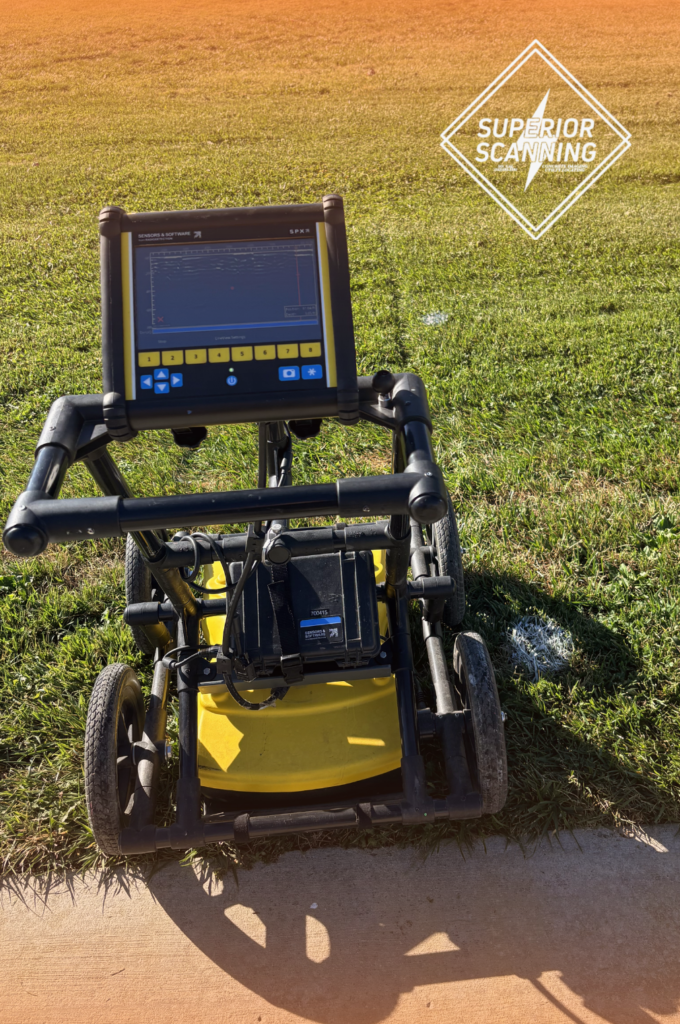

A new slab can feel predictable, but the concrete already conceals the systems embedded within it. Scanning concrete remains essential before drilling, coring, anchoring, or cutting, as new slabs often contain hidden rebar, post-tension cables, and electrical conduit. While construction plans document the intended layout, field scanning reveals what is actually present in the work area.
Professional ground-penetrating radar (GPR) concrete scanning services provide a nondestructive method for investigating these features. Superior Scanning uses concrete scanning services across Southern California to identify detectable targets before any intrusive work begins.
Don’t Cut, Core, or Drill Blind
Superior Scanning is trusted on complex job sites
What Can Be Inside a New Slab?
A new concrete slab may contain many of the same embedded features that contractors scan for in an older slab:
- Rebar and wire mesh: Structural reinforcement can run through large portions of a slab.
- Post-tension cables: Some structural slabs contain stressed tendons that require careful coordination before penetrations.
- Electrical conduit: Power, data, or communication conduit may cross planned drilling or cutting areas.
- Plumbing or embedded lines: Some projects place piping or other building systems within concrete.
- Sleeves and penetrations: Preplanned openings can remain hidden once the slab is finished.
- Structural reinforcement: Extra steel may occur around columns, beams, openings, or other structural zones.
- Other embedded components: Project-specific hardware or systems may also be present.
“New” describes the concrete’s age, not the absence of embedded material. A GPR concrete scanner can function as a rebar scanner or detector for reinforcement mapping, while broader concrete slab scanning can also detect post-tension cables and other detectable conduits.

Do New Drawings Replace a Scan?
No. Current drawings are valuable, but drawings and field scanning answer different questions. Plans provide project context, while a concrete scanner collects information from the accessible slab area where a penetration or cut is proposed.
Using both gives the field crew more useful information before making layout decisions.
Design Intent
Structural and mechanical, electrical, and plumbing (MEP) drawings show the planned reinforcement, conduit routes, sleeves, openings, and related building components.
Field Conditions
A GPR scanner collects data from the actual work zone. Scanning concrete allows the technician to compare detectable slab features with the proposed drill, core, anchor, or cut location.
Construction Changes
Routing or placement may change during construction due to field coordination or installation constraints. That does not make the drawings unreliable, but it is one reason field information may be useful when planning a penetration.
Added Verification
You can review available plans alongside GPR data, rather than treating either source as complete on its own. Superior Scanning recommends having structural or as-built plans available, as they provide useful context before scanning begins.
Why Scan Before New Penetrations?
Scanning before a new penetration gives crews information about detectable embedments already installed in the slab. This can be useful even when the concrete was poured recently because follow-up trade work may require new holes, anchors, cuts, or equipment connections.
The scan helps crews evaluate possible locations without assuming the slab is empty.
Late Design Changes
New plumbing routes, electrical work, equipment anchors, or floor penetrations may be added after the original pour. Concrete scanning can document detectable features around the revised work area.
Trade Coordination
Surface markings can help mechanical, electrical, plumbing, concrete, and coring crews coordinate around interpreted targets before work starts.
Penetration Placement
Scan information can support evaluation of possible core, drill, anchor, or cut locations. The final location still needs to account for project requirements and structural restrictions.
Existing Embedments
Recently installed rebar, post-tension cables, and conduit are still physical obstacles. New construction does not remove the need to consider those features before intrusive work.
Don’t Cut, Core, or Drill Blind
Superior Scanning is trusted on complex job sites
Can New Concrete Affect Ground Penetrating Radar Services?
Yes. The age and moisture condition of new concrete can influence how radar energy travels through the slab. Fresh or moist concrete can weaken GPR signals more quickly, which may reduce penetration or make deeper reflections harder to interpret.
As concrete cures and loses moisture, the effect changes, so a technician must evaluate actual field conditions rather than assuming every new slab will scan the same way.
Higher Moisture
Newly placed concrete generally contains more moisture than concrete that has had more time to dry. Water changes the electromagnetic properties that affect radar travel.
Signal Attenuation
Moist or conductive concrete can cause radar energy to lose strength as it passes through the material. FHWA specifically notes that GPR penetration can be adversely affected by moisture in concrete, including fresh concrete.
Changing Conditions
Concrete properties continue to change as water content decreases. Research using GPR measurements from day 3 through day 150 after casting found that changes in water content altered dielectric properties and the attenuation of electromagnetic waves.
Technician Judgment
A technician may adjust the GPR scanner setup and interpretation based on moisture, reinforcement density, expected depth, and the quality of the collected concrete radar data. Ground penetrating radar services therefore depend on field conditions as well as equipment.
When Should a New Slab Get Concrete Scanning Services?
Concrete scanning services are most useful when planned work could intersect concealed slab features or when the proposed location needs field verification:
- Before concrete core drilling or related penetrations
- Before saw cutting or slab trenching
- Before installing anchors or equipment
- Before adding plumbing or electrical penetrations
- When post-tension reinforcement may cross the work area
- When drawings do not clearly resolve a proposed location
- When field conditions need comparison with available plans
- When a penetration location changes after the original pour
The slab’s age alone does not determine the need for concrete scanning. The planned work and uncertainty around the target area matter more.
Contractors evaluating concrete scanning companies should also confirm that the provider handles concrete slab scanning, as this work differs from underground scanning services used for buried utilities outside the concrete structure.

What Does a Concrete Scanner Show in a New Slab?
A new-slab scan provides field information on detectable embedded features within the accessible area under examination. Results depend on target type, concrete conditions, depth, reinforcement density, equipment, and interpretation.
The goal is useful layout information for the planned work, not a claim that every object inside the concrete has been identified.
Reinforcement Layout
GPR can show likely rebar patterns and spacing where signal conditions allow. Steel often produces a strong radar response.
Post-Tension Paths
A technician can map likely post-tension (PT) cable paths when radar responses and site conditions support interpretation.
Conduit Locations
Detectable metallic and nonmetallic conduits may appear in GPR data, although signal quality depends on material, depth, size, surrounding reinforcement, and concrete conditions.
Depth Information
GPR can estimate target depth when the radar response and assumed or calibrated wave velocity support the calculation.
Surface Markings
Interpreted targets can be marked directly on the slab, allowing crews to compare findings with proposed work locations. Superior Scanning uses the Proceq GP8000 for concrete scanning and provides field markouts tied to scan interpretation.
Does a New Slab Guarantee Clear Results?
A new slab does not automatically guarantee clearer GPR results. Concrete age is only one part of the scanning environment, and recently placed concrete may contain enough moisture to reduce radar penetration.
Scan clarity can also depend on:
- Concrete moisture
- Reinforcement density
- Target depth
- Slab thickness
- Closely spaced embedded objects
- Access to the scanning surface
- Surface coverings or obstructions
Superior Scanning states that the usable depth and clarity of its concrete GPR equipment can vary with concrete age, moisture content, and rebar density. Interpret a scan based on actual field data rather than assumptions about slab age.
Don’t Cut, Core, or Drill Blind
Superior Scanning is trusted on complex job sites
Frequently Asked Questions
Do you need to scan concrete before drilling?
Scanning concrete is commonly used before drilling when rebar, conduit, post-tension cables, or other embedded features may cross the proposed location, although GPR is not a universal legal requirement for every drilling task.
Can GPR scan newly poured concrete?
GPR can be used on relatively new concrete, but higher moisture in early-age concrete can increase signal attenuation and affect penetration or interpretation, so timing and usefulness depend on slab conditions and the project goal.
What can a concrete scanner detect?
A concrete scanner can help identify or map detectable rebar, wire mesh, post-tension cables, conduits, voids, and thickness changes, but results depend on material type, target depth, moisture, reinforcement density, and equipment.
Can GPR detect rebar in concrete?
Yes. Rebar is a common target for GPR concrete scanning because steel produces strong radar reflections, although closely spaced reinforcement, target depth, and concrete conditions can make interpretation more difficult.
How deep can a concrete scanner detect objects?
There is no universal scanning depth, but Superior Scanning states that handheld units such as the Proceq GP8000 are typically effective up to about 18 to 24 inches under suitable conditions, while 12 to 14 inches is more common for high-resolution imaging.
New Slab, So Why Guess?
New concrete can still benefit from scanning when drilling, coring, anchoring, or cutting are planned, as reinforcement and building systems may already be embedded in the slab. Drawings add valuable context, while field scanning provides additional information about the actual work area, and fresh-concrete moisture can also affect GPR performance.
Superior Scanning provides concrete scanning services for active construction and facility projects across Los Angeles, Orange, Riverside, and San Diego Counties.
Provide the proposed cut, core, drill, or anchor locations when requesting availability or a project quote.
