
Every commercial contractor knows the tension of firing up a core drill on an older slab. You cross your fingers and hope the outdated municipal blueprints are actually accurate this time.
But guessing is a massive financial risk. Project managers frequently ask exactly what is a ground penetrating radar (GPR) and why site inspectors now make it a strict requirement before anyone brings heavy machinery indoors.
Hitting an unseen pipe or live electrical wire triggers instant liability fines and brings your progress to a dead stop. Partnering with a reliable team like Superior Scanning provides the exact subsurface data you need to avoid those disasters. Integrating professional ground-penetrating radar services removes dangerous blind spots. It keeps excavation crews perfectly safe and ensures your commercial developments run strictly on schedule.
Table of Contents
Don’t Cut, Core, or Drill Blind
Superior Scanning is trusted on complex job sites
How Does Subsurface Imaging Prevent Disaster?
You cannot just trust the smooth surface of a concrete floor. Subsurface imaging acts like an X-ray for the job site. Advanced GPR imaging eliminates the very real danger of blindly cutting into solid concrete. This crucial preparation protects the structural integrity of the entire building while shielding workers from unexpected and severe safety hazards.
Detecting Embedded Rebar
Hitting thick steel grids easily snaps expensive drill bits. Worse, cutting the wrong support causes floors to sag over time. Technicians map these metal reinforcements ahead of time, allowing you to guide the core drill safely through the empty pockets.
Avoiding Live Conduits
Striking an active electrical line is a terrifying experience on a job site. It causes dangerous arc flashes and knocks out power to the whole facility. Scanning the floor pinpoints these live wires, giving your crew the exact boundaries needed to maintain a perfectly safe distance.
Preserving Post-Tension Cables
Slicing through a high-tension cable acts like a bomb going off inside the concrete. It severely weakens the foundation and can cause immediate physical harm. Finding those exact cable paths helps ensure heavy machinery avoids compromising the stability of the structure.
How Does GPR Work in Commercial Construction?
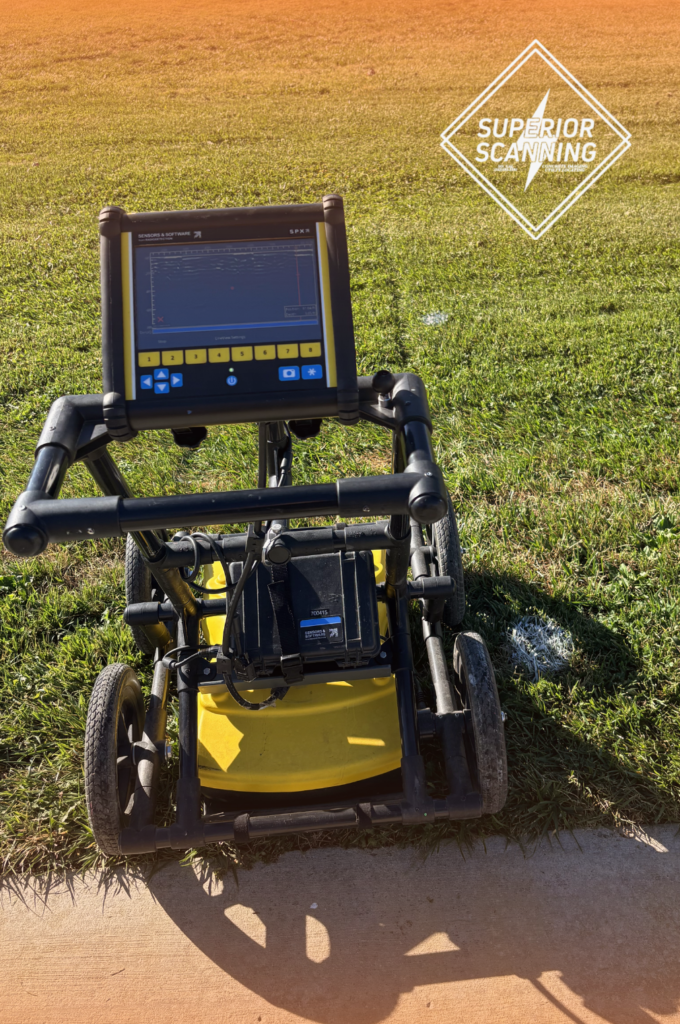
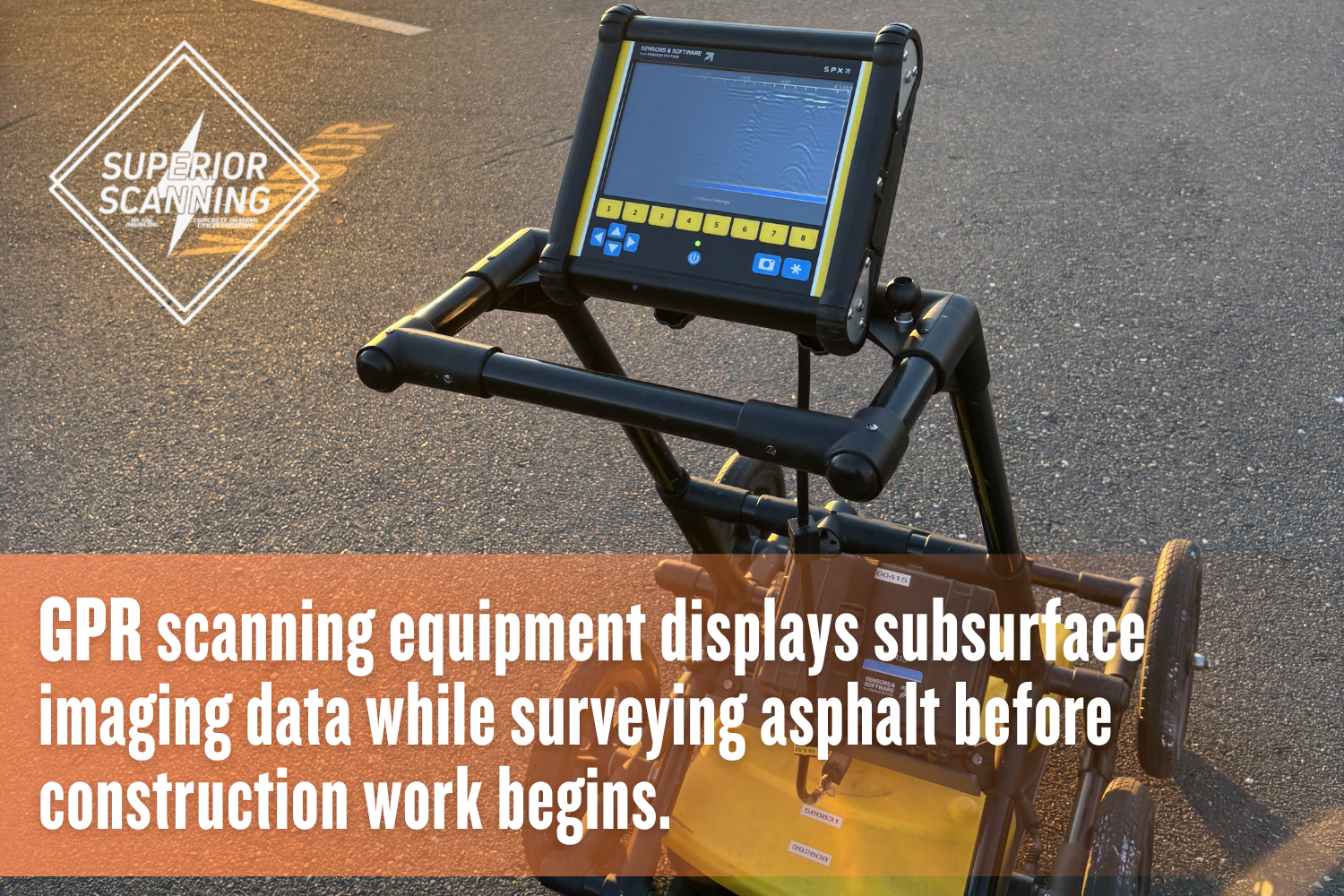
Bringing GPR in construction planning provides a highly reliable, completely non-destructive way to evaluate a site. When framing crews see technicians rolling a specialized cart across the floor, they usually ask how GPR works in real time. The equipment follows a very precise sequence of actions to safely locate hidden targets.
Emitting High-Frequency Radar
The scanning cart sends incredibly fast pulses of radio energy straight into the solid floor. These invisible waves travel downward until they hit something with a different density than the surrounding concrete.
Recording Signal Reflections
Once those radio waves strike a buried PVC pipe or steel rod, the signal bounces right back up to the surface antenna. The software inside the unit immediately records the exact timing and strength of those returning echoes.
Mapping Subsurface Anomalies
Finally, the computer translates those reflected signals into a visual graph. Experts read this real-time screen to figure out the exact depth and location of the target. Then, technicians mark the hazard directly on the concrete with paint.
Don’t Cut, Core, or Drill Blind
Superior Scanning is trusted on complex job sites
What Impacts Ground Penetrating Radar Depth?
No two job sites are exactly alike. Environmental conditions and the actual materials on site heavily impact ground penetrating radar depth during a routine evaluation. Pulling off a successful GPR scan requires a deep understanding of the physical environment, as certain conditions naturally limit how far down the equipment can see. Professionals adjust the approach based on several specific factors that affect signal penetration:
- Thickness and density of the concrete slab
- Moisture and water content trapped within the material
- Proximity of tightly spaced reinforcing steel
- Antenna frequency selection on the scanning device
Why Choose Professional GPR Testing?
Guessing utility pathways based on faded, twenty-year-old blueprints almost always leads to a disaster. Site managers need absolute precision when navigating complex environments to avoid costly shutdowns. Relying on professional GPR testing prevents those terrifying utility strikes. Bringing in specialized technicians gives you several major advantages:
- Accurate hazard identification before breaking ground
- Immediate, real-time data interpretation on the job site
- Completely non-destructive evaluation of the facility
- Comprehensive integration of GPR in construction planning
Don’t Cut, Core, or Drill Blind
Superior Scanning is trusted on complex job sites
Frequently Asked Questions
What does GPR stand for in construction?
GPR stands for Ground Penetrating Radar, which is a non-destructive geophysical method that uses radar pulses to image the subsurface of concrete, soil, and asphalt.
Can a GPR scan find PVC pipes in concrete?
Yes, unlike traditional magnetic locators, the equipment detects the density difference between a plastic PVC pipe and the surrounding concrete or soil.
How accurate is commercial concrete scanning?
When operated by a trained professional, the equipment accurately pinpoints the location and depth of embedded targets within a fraction of an inch.
Does ground penetrating radar emit harmful radiation?
No, the technology emits exceptionally low-frequency radio waves that are entirely safe for operators, bystanders, and active medical facility environments.
How much time does a commercial scan take?
A standard commercial concrete survey typically takes just a few hours, though the exact timeline depends entirely on the size of the scanning area and the complexity of the grid.
Will Hidden Hazards Stop the Next Core Drill?
Trenching blindly into a commercial slab is a massive financial and safety risk that no modern contractor can afford to take. Utilizing professional ground penetrating radar services promotes a safe, compliant, and highly efficient excavation phase.
Superior Scanning provides rapid, highly accurate GPR scanning to keep Southern California job sites on schedule. Request a competitive flat-rate or hourly quote today to protect the crew and keep the next renovation strictly on track.
